Resources
We’ve created this page to keep you up to date with helpful information and resources!
Jump to: Documents What we’re reading

Jump to: Documents What we’re reading
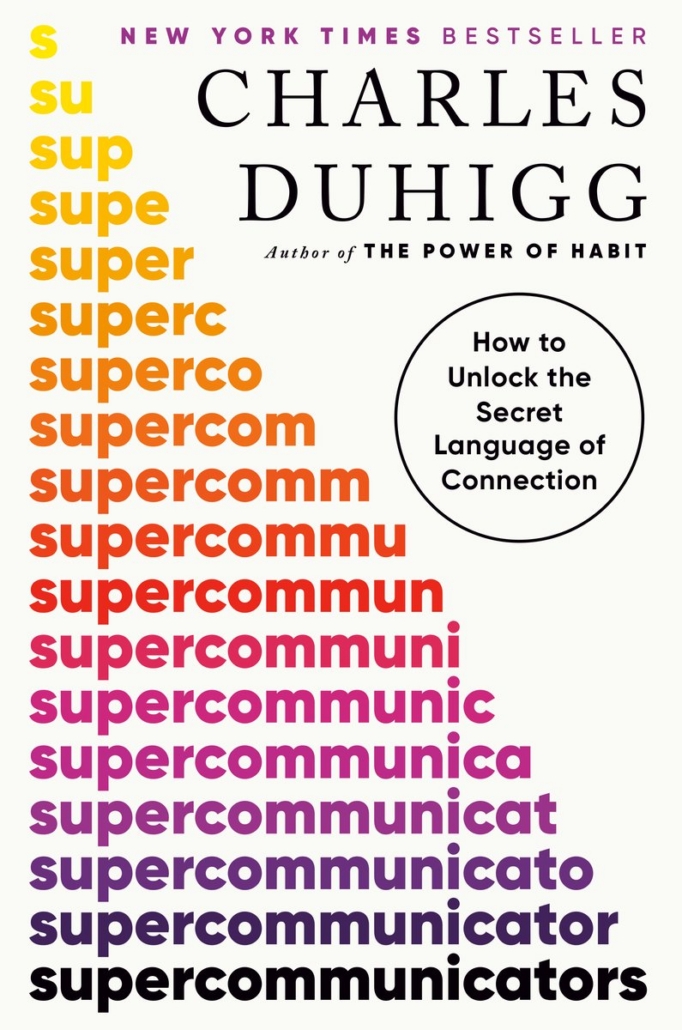
by Charles Duhigg
Random House, 2024
Humans are wired for connection.
“When we ‘click’ with someone, our eyes often start to dilate in tandem; our pulses match; we feel the same emotions and start to complete each other’s sentences within our heads. This is known as neural entrainment, and it feels wonderful.”
Supercommunicators aims to help us enjoy more of these moments of connection by having better conversations. The book offers stories of people finding ways to connect despite differences: gun control advocates in dialogue with NRA members; pediatricians engaging with vaccine-skeptical parents.
“Effective communication requires recognizing what kind of conversation is occurring and then matching each other.” According to Duhigg, there are three types of conversations:
Miscommunication often happens when people are having different types of conversations without realizing it. If we can identify what type of conversation the other person wants to have, we can move in that direction too. Duhigg outlines the steps to what he calls The Learning Conversation:
“The most important goal of any conversation is to connect.” Not to convince, not to persuade. As one of Duhigg’s subjects puts it: “what durable and pliable creatures we are and what a house of goodwill lurks in the social fabric.”
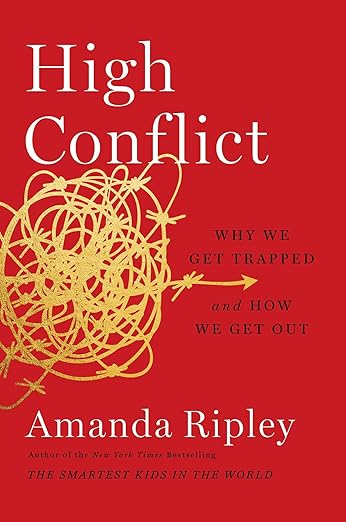
by Amanda Ripley
Simon & Schuster, 2021
High Conflict’s diverse cast of characters has only one thing in common: they’re all real people engaged in conflicts that are destroying their lives. Ripley uses her journalistic curiosity to explore: why do humans get into all-consuming conflicts, and how can we get ourselves out?
Ripley’s answer focuses on internal shifts that are simple but not necessarily easy. Conflict and polarization are so tempting because they are grounded in basic human needs like belonging, self-esteem, control, and meaning. Yet, there are ways forward:
Complicate the binary. Polarization is much more likely when we have, or think we have, only two options.
Reframe the situation. A gang member realized his conflict was not with the rival gang but with the racist system that produced gang culture. Another person reframed being yelled at, not as humiliation, but as an opportunity to understand the other person’s needs.
Look for the saturation point. The subjects of Ripley’s book all decide to disengage from their conflicts when the conflict itself has become more uncomfortable than the challenge of stepping back from it. As individuals and as a culture, we can create safe, nonjudgmental ways for people to retreat from conflict.
Expand identity—your own and others. Sometimes conflict can become our identity. The solution is to remember the many identities we each hold and lean into identities other than the conflict. We can also remind ourselves of our opponents’ multiple identities and all we have in common.
Listen and build relationships: “Relationships change us way more readily than facts.”
Time and space interrupt conflict. Ask a question with genuine curiosity rather than responding immediately. Pause, take a deep breath and ask yourself: Does it need to be said? Does it need to be said by me? Does it need to be said by me right now?
by Loretta J. Ross
Simon &Schuster, 2025
Loretta Ross—wow!—what a model of courage and compassion! Not only did she found the reproductive justice movement; over the course of her long career, she has deprogrammed white supremacists, taught convicted rapists the principles of feminism, and organized the massive 2004 March for Women’s Lives.
Ross tells stories of her life and work, from the traumatic to the inspiring, with impressive vulnerability. And she uses her experience to teach us the vital practice of calling in. According to Ross, “calling in is about offering love, respect, and compassion to those with whom you disagree.” This means pausing to examine our own intentions, speaking with love, and being willing to listen in return.
Ross isn’t saying that callouts are never necessary. But, while calling in can start a conversation, calling out can alienate potential allies. “Many people mistakenly believe that only perfectly united ideological movements are effective… When many people have different ideas but move in the same direction, that’s a movement. When many people have the same idea and move in the same direction, that’s a cult.”
At DSC, we believe that dialogue supports community. Differences make our community stronger, if we know how to navigate them with integrity and empathy. Calling In is a welcome reminder and guide for the practice of living and belonging together.